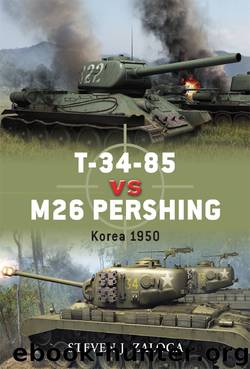
T-34-85 vs. M26 Pershing by Steven Zaloga
Author:Steven Zaloga
Language: eng
Format: epub
Tags: T-34-85 vs M26 Pershing: Korea 1950
ISBN: 9781780962290
Publisher: Osprey Publishing
Published: 2011-11-13T16:00:00+00:00
The NKPA T-34-85s were almost all from 1945 and 1946 production batches. This particular example is in the Uralvagon Plant No. 183 configuration, evident from the shape of its turret casting.
Besides the T-34-85, the other major NKPA armored vehicle was the SU-76M assault gun. This SU-76M was knocked out along the road to Taegu in the Waegwan sector of the Pusan perimeter during the fighting, on August 20, 1950, with the 27th Regimental Combat Team (RCT), 25th Infantry Division.
One of the main problems facing the Soviet instructors was the shortage of translators. Few Russians had any knowledge of the Korean language, and most of the Korean soldiers who had served in the Red Army in World War II were earmarked for command slots in the NKPA, not for employment as translators. Indeed, many of the higher-level command documents were written in Russian. The brigade never trained to operate as a unified unit; rather, it was intended for use in its component parts for infantry support, with the individual tank regiments attached to infantry divisions in the offensive.
With its full complement of equipment on hand, the component elements of the brigade were dispatched to separate bases for further training. The 107th Tank Regiment, commanded by Col. Choe U Sik, along with the brigade’s infantry, motorcycle, and training regiments remained at the original Sadong base. The 109th Tank Regiment, commanded by Col. Kim Tae Ryon was shipped to Chorwon, where the troops worked through December 1949 creating their own barracks. The 203rd Tank Regiment, led by the former commander of the 1st Battalion, 15th Tank Training Regiment, Col. Choe Ul Suk, was sent to Namchonjom.
The training in early 1950 consisted of instrument familiarization, operation of the tank radio and intercom system, operation of the 85mm gun and 7.62mm machine gun, and driving instruction. The crew members were taught only the skills needed for one position in the crew; there was no cross-training. Gunnery instruction was limited by parsimonious allotments of practice ammunition, and in general there was little or no practice in tank-vs.-tank fighting, since it was presumed that no enemy tanks would be encountered. Captured prisoners indicated that they had only fired two rounds of live main gun ammunition in pre-war practice. Although North Korean tanks did carry AP ammunition, the standard crew drill stressed the use of HE ammunition, which was the principal type used in the 105th Armored Brigade. Most of the units conducted three-day, battalion-level exercises prior to the start of the war. Further details of North Korean tank crew training are scant due to the severe losses suffered by the units in combat.
At the time of the North Korean invasion of South Korea in June 1950, the NKPA possessed 242 T-34-85 tanks, about half of them in the 105th Armored Brigade, including the 20 tanks with its 208th Tank Training Regiment. The remainder were intended as replacements or for new armor units. In contrast to the extensive training provided to the 105th Armored Brigade, the follow-on units received only hasty training (often as little as a month), mainly from the North Korean cadre.
Download
This site does not store any files on its server. We only index and link to content provided by other sites. Please contact the content providers to delete copyright contents if any and email us, we'll remove relevant links or contents immediately.
Shoot Sexy by Ryan Armbrust(17732)
Portrait Mastery in Black & White: Learn the Signature Style of a Legendary Photographer by Tim Kelly(17008)
Adobe Camera Raw For Digital Photographers Only by Rob Sheppard(16982)
Photographically Speaking: A Deeper Look at Creating Stronger Images (Eva Spring's Library) by David duChemin(16691)
Bombshells: Glamour Girls of a Lifetime by Sullivan Steve(14081)
Art Nude Photography Explained: How to Photograph and Understand Great Art Nude Images by Simon Walden(13052)
Perfect Rhythm by Jae(5410)
Pillow Thoughts by Courtney Peppernell(4287)
The Book of Joy by Dalai Lama(3995)
Good by S. Walden(3564)
The Pixar Touch by David A. Price(3444)
A Dictionary of Sociology by Unknown(3088)
Fantastic Beasts: The Crimes of Grindelwald by J. K. Rowling(3061)
Stacked Decks by The Rotenberg Collection(2885)
Humans of New York by Brandon Stanton(2876)
Read This If You Want to Take Great Photographs by Carroll Henry(2713)
On Photography by Susan Sontag(2643)
Insomniac City by Bill Hayes(2561)
Photographic Guide to the Birds of Indonesia by Strange Morten;(2538)
